In the past, however, water was provided by three big cisterns from which it was transferred to the city's historic fountains. When these massive reservoirs became obsolete, they were converted into vegetable gardens. The smallest of these reservoirs, near Edirnekapi, was named Aetius and measured 244 by 85 meters. It is now used as a stadium. Cukurbostan (the Sunken Garden), located near the Sultan Selim Mosque, measures 152 square meters on each side. The Hagios Makioe Reservoir measures 170 meters by 147 meters and is 15 meters deep.

Historical fountains cisterns in Istanbul
Many of the city's best-known water monuments are easy to combine with visits to major landmarks such as Sultanahmet Square, Topkapi Palace, and the famous Basilica Cistern. Together, these sites reveal how practical water infrastructure also became a form of imperial architecture.
Fountain of Sultan Ahmet III in Sultanahmet
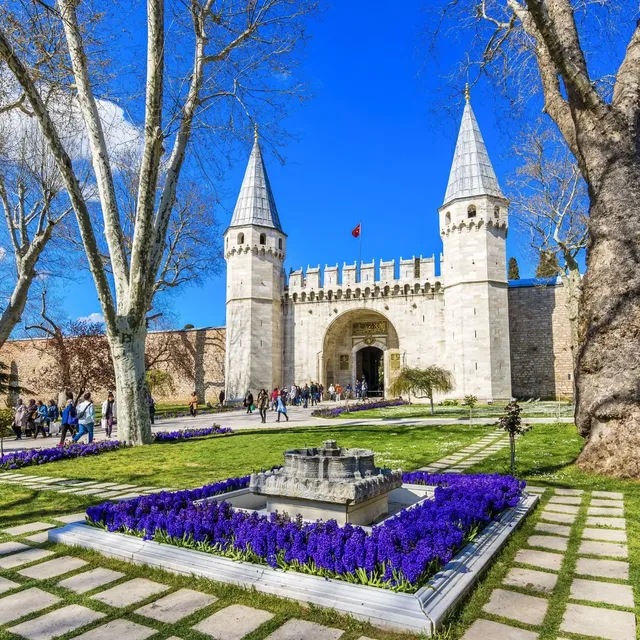
It is a lovely baroque-style historical fountain that was erected in 1728 and is located in front of the Topkapi Palace Imperial Gate. Its prominent setting makes it one of the easiest Ottoman fountains to notice while exploring the historic center.
German Fountain in Sultanahmet
The German Fountain, commonly known as the "Fountain of Kaiser Wilhelm II," is a magnificent fountain between Sultanahmet Square and the Blue Mosque. It has beautiful architecture with columns and a lovely dome.
Tophane Fountain in Tophane
The Tophane Fountain is a lovely baroque-style historical fountain located in Tophane, near Galata and Karakoy, between the Kilic Ali Pasa and Nusretiye Mosques. It was established in 1732 by Sultan Mahmut I and features beautiful architecture with marble walls adorned with flowers.
Fountain of Sultan Ahmet III in Uskudar
The Fountain of Sultan Ahmet III, which was created in 1728, is a wonderful historical structure. The Fountain's four sides are all covered with verses, some of which belong to Sultan Ahmed III.
Cisterns in Istanbul
Basilica Cistern
The Basilica Cistern, which Emperor Justinian built in 532, is also known as the Basilica Cistern because it is located under the Stoa Basilica. The cistern is a giant structure covering a rectangular area of 140 meters in length and 70 meters in width. There are 336 columns inside the cistern, each 9 meters high, which is descended by a 52-step stone staircase. These columns, erected at intervals of 4.80 meters from each other, form 28 rows of 12 each row.
These pillars rising in the water remind them of a vast forest and impress visitors as soon as they enter the cistern. The ceiling weight of the cistern was transferred to the columns by means of round cruciform vaults and arches. Most of the columns, most of which are understood to have been collected from older structures and carved from the granite of various types of marble, consist of one piece, and some of them are two pieces on top of each other.
The headings of these columns have different features from place to place. While 98 of them reflect the Corinthian style, some reflect the Doric style. The brick-built, 4.80-meter-thick walls and brick-tiled floor of the cistern were plastered with a thick layer of Horasan mortar and made watertight. This cistern, which has 9,800 square meters, has a water storage capacity of approximately 100 thousand tons.
The two Medusa heads used as pedestals under the two columns in the northwest corner of the cistern are among the masterpieces of Roman sculpture art. Although there is no certain information about which building these heads from the 19th century were brought here, it is thought that they were brought here after being dismantled from an ancient structure belonging to the Young Roman Age. Those who came to visit the cistern watched in amazement.
For broader historical background on Byzantine water systems and the monument itself, you can also consult Wikipedia's Basilica Cistern entry and check current visitor information on official or museum resources before you go.
Bozdogan (Valens) Aqueduct in Vefa
The Bozdogan Aqueduct, a kilometer-long aqueduct erected in 375 by the Roman Emperor Valen, provides a stunning feature of the region's scenery. Its purpose was to transport water to the city.
Although aqueducts are different from fountains and cisterns, this structure helps explain the bigger network behind Istanbul's historic water system. In that sense, it connects the city's underground reservoirs with the public fountains that once distributed water across neighborhoods.
Why these water monuments matter
Istanbul's fountains and cisterns are more than decorative or isolated monuments. They show how Roman, Byzantine, and Ottoman builders adapted to the needs of a growing city. Some structures stored water, some moved it, and others displayed it in highly artistic ways. That combination of engineering and aesthetics is what makes them so memorable today.
If you want to deepen your understanding of Istanbul's historic urban landscape, UNESCO's overview of the city's heritage is also useful: Historic Areas of Istanbul.
Planning your visit
- Start in Sultanahmet to see the Fountain of Sultan Ahmet III, the German Fountain, and nearby monumental sites.
- Visit the Basilica Cistern to experience the underground side of Istanbul's water history.
- Head to Tophane for another fine Ottoman fountain in a different part of the city.
- Add the Valens Aqueduct in Vefa for a better sense of the infrastructure that fed the city.
FAQ about fountains cisterns in Istanbul
What is the most famous cistern in Istanbul?
The most famous cistern is the Basilica Cistern. It is known for its vast underground chamber, 336 columns, atmospheric lighting, and the two Medusa head bases in the northwest corner. It is one of the city's best-known Byzantine monuments.
Where can I see historic fountains in Istanbul?
You can see notable historic fountains in Sultanahmet, Tophane, and Uskudar. Among the best known are the Fountain of Sultan Ahmet III in front of Topkapi Palace, the German Fountain near the Blue Mosque, and the Tophane Fountain.
Are Istanbul's cisterns and fountains from the same period?
No. The water monuments of Istanbul come from different eras. The Basilica Cistern dates to the Byzantine period, while many of the city's celebrated public fountains, including examples linked to Sultan Ahmet III, belong to the Ottoman period.
What is the difference between a cistern, a fountain, and an aqueduct?
A cistern stores water, a fountain distributes or presents it in a public setting, and an aqueduct carries water from one place to another. In Istanbul, these three types of structures worked together as parts of a larger urban water system.