Completed in four and a half years on the Asian side of the city, in a corner of Karacaahmet Cemetery, Şakirin Mosque attracted foreign media attention during construction and continued to draw notice after its opening in May. For travelers exploring Istanbul’s religious architecture, it offers a very different experience from monumental classics such as the Blue Mosque or the vast Suleymaniye Mosque.
Sakirin Mosque Istanbul and its story
The mosque was built in memory of the charitable Semiha Şakir and her Saudi husband İbrahim Şakir by their children Gazi, Ghassan and Gade Şakir. It was designed by Hüsrev Tayla. Tayla, however, left the project before its completion and transferred the concluding phase to his student. Zeynep Fadıllıoğlu carried out the mosque’s interior decoration and design. The mosque has indoor and outdoor parking, a built area of 10 thousand square meters, a square plan, and a capacity for 500 people.
Zeynep Fadıllıoğlu is well known both in Turkey and abroad. She has said that the aim was to combine classical architecture with modern lines. Yet the final result was not the work of one person alone. The family collaborated with many artists and craftsmen to create this modern splendor, and the harmony of those contributions is essential to the building’s identity. Fadıllıoğlu also carried the distinction of being the first woman to make the interior designs of a mosque, which made the pressure on the project even more apparent.
The exterior: simplicity, irony, and the shell dome
The construction took four and a half years and contains interesting details from many angles. Outside, the mosque stands among the centenary cypresses of Karacaahmet Cemetery. The first thing seen is the pair of minarets rising near the dome. There is no minaret balcony, as the azan is projected by loudspeaker.
At first glance, the exterior appears quite simple. Its dome is covered with aluminum composite panels in the form of fish scales, in a style described as a shell dome. At night, ultramodern lighting turns the dome blue, an effect created by the English artist Arnold Chan.
Those interested in architecture may notice a resemblance between the exterior and the Ankara Kocatepe Mosque project associated with the architect Vedat Dalokay. In an ironic turn, Dalokay’s project had reportedly been rejected on the grounds that a shell dome would not endure over time, while Hüsrev Tayla’s classical mosque project had been accepted instead. The mosque standing in Üsküdar today is, in effect, Hüsrev Tayla’s mosque with a shell dome.
Approaching the building, grey tones dominate. Dark grey Kayseri stones were used in the construction, while the exterior composition was shaped by architect and painter Kadir Akorak.
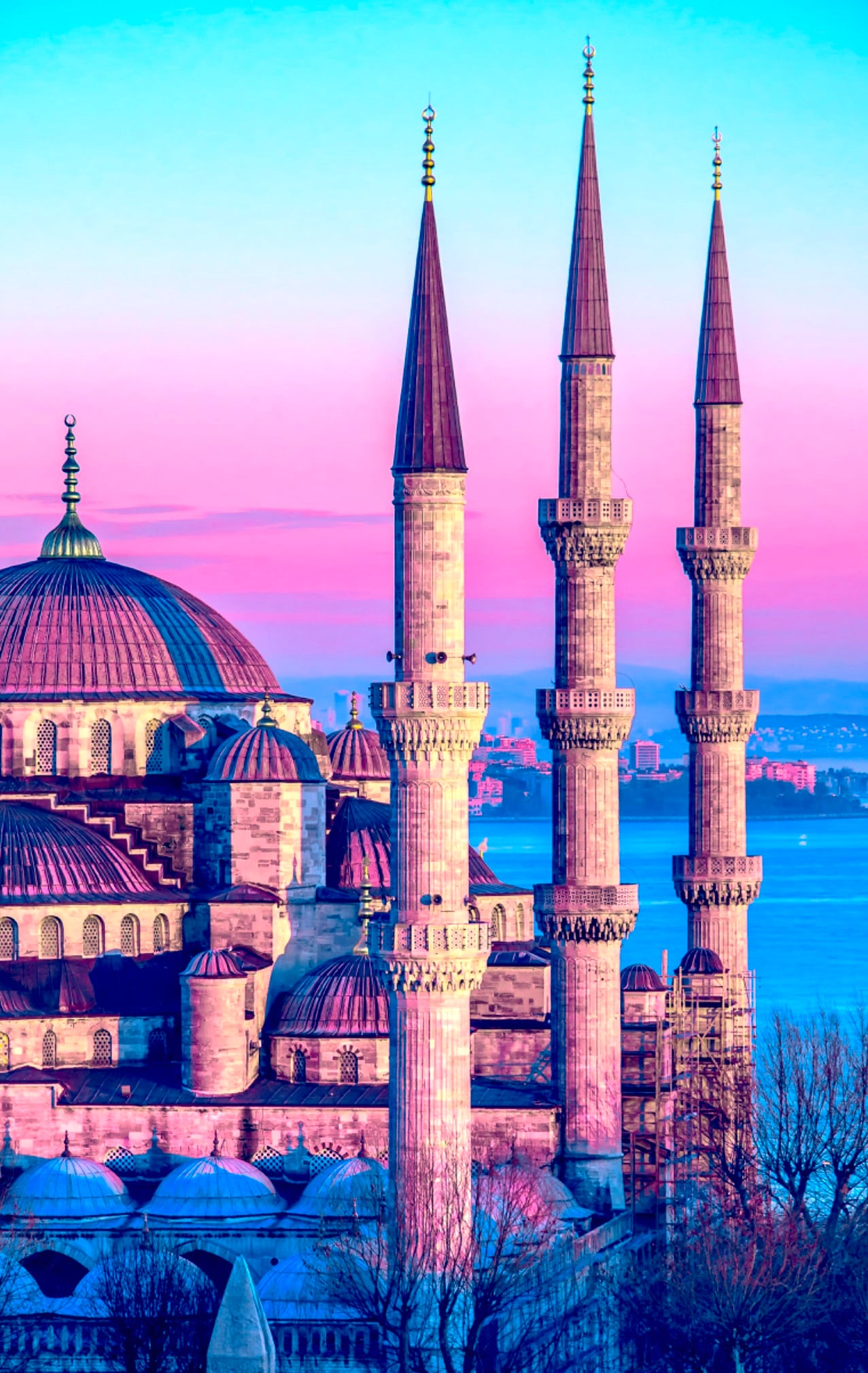
The courtyard and fountain
A ramp and easy-to-climb stairs lead visitors to the inner court. The small pool that greets you also functions as the fountain. At its center sits a sphere symbolizing the cosmos. Wherever you look on its small surface, the image of the mosque and minarets appears. This transparent dome-like sphere was designed by the London sculptor William Pye.
Even here, before entering the prayer hall, the mosque signals that it wants to reinterpret familiar religious space through contemporary artistic language.
The interior surprise
The exterior remains plain apart from the shell dome, and even the narthex is notably restrained. The real surprise is inside. As soon as you step into the mosque, a turquoise bright yellow altar welcomes you. It creates such an immediate visual impression that it asks the visitor to pause and absorb it. The altar gives the impression of an amulet.
The pulpit beside it is rendered in a lighter yellow. From a distance it seems to be covered in calligraphy, but closer inspection reveals ornamental leaf patterns on the 12-stage pulpit. These leaves were designed by Tayfun Erdoğmuş, head of the Faculty of Fine Arts at Marmara University, to represent the cosmos. The altar is so captivating that one might almost overlook the hand-knotted camel hair carpet on the floor, where burgundy lines mark the prayer rows.
Every special feature in the mosque was designed by a master. The chandelier, made with plexiglass, metal, mirrors and glass, bears the signatures of three artists. Stained-glass master Orhan Koçan created the plexiglass and metal elements, Nahide Büyükkaymakçı made the crystal, and Nur Sûre conceived the chandelier as large nested circles. The chandelier has three rings and includes God’s 99 names, while the prayers were written by the calligrapher Hüseyin Kutlu.
Its most impressive aspect is not simply the size or geometry, but the crystal drops that seem to flow gently like water from the circles. The idea behind it is elegant: rain, understood as God’s compassion, descending upon the prayers.
Light, glass, and calligraphy
Şakirin Mosque is enclosed with glass on three sides. Unlike many conventional mosque designs and other places of worship, it is notably luminous. This brightness makes interior and exterior feel closely connected. You can see outside easily from within, while it remains difficult to see inside from outside because of the original window grilles.
These panes contain more meaning than first appears. Each casement is stylized like the pages of the Quran. From a distance, they resemble white pages inscribed in gold. The effect suggests being inside the holy book itself, in an atmosphere where the text accompanies hope, gratitude and prayer.
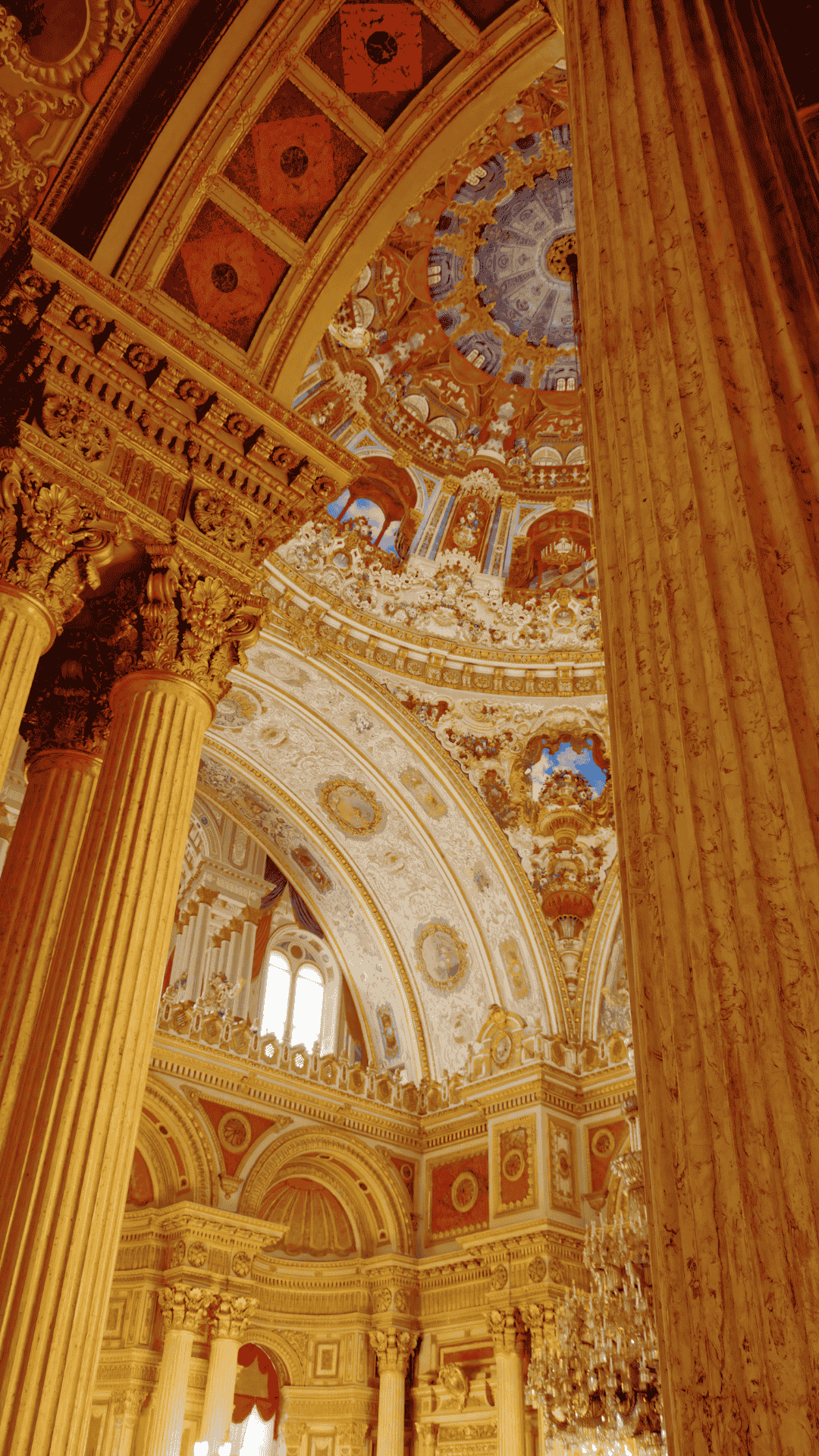
The dome is central to mosque architecture both outside and inside. Indoors, the main dome is earth-toned and inspired by the colors of Tophane, while red dominates the walls framing the windows. The center of the dome, designed by Semih İrteş and based on a Tophane pattern from Topkapi Palace, is enclosed with Fatır Sûre and then circled with Mülk Sûre by Hüseyin Kutlu. The figures between the lines are by Orhan Koçan. At the corners are boards carrying the names God, Mohammad, Hz. Ebubekir, Hz. Ömer, Hz. Osman, Hz. Ali, Hasan and Hüseyin.
Semih İrteş argued that every important structure should rest on a clear underlying idea, and insisted that such an idea be established before the project began. The writing running through the dome binds the bands together in a pinwheel form, intended to express the rotation of the world and planets. All of the calligraphy in the mosque was executed in 23-carat gold foil and took two years to complete. It is also significant that the Şakirin brothers chose all the prayers used in the mosque.
Ottoman and Seljuk motifs together
Ottoman and Seljuk motifs are used together throughout the mosque. Seljuk motifs appear more strongly in the women’s gathering area on the balcony. The barriers there resemble lace or perforated tulle, creating a mysterious atmosphere animated by light and shadow.
The mosque also pays attention to hygiene and modern facility standards. Separate men’s and women’s toilet facilities were designed to a very high standard. A private company was planned to handle cleaning, while security guards would protect the mosque. The design also included an educational display, air-conditioning and heating, a projector, and a sound system.
Museum section and why the mosque matters
Outside, in the museum section, four pieces of Ka'bah blanket are displayed. They were purchased from Sotheby’s at great expense. There are also collections of İznik pottery and inherited Turkish Islamic arts.
It is often described as Turkey’s, if not the world’s, most modern mosque. The BBC’s Dorian Jones described it as “The most radical mosque designs of Turkey that continues for generations.” Whether viewed primarily as an architectural work, a family memorial, or an interior design landmark, the mosque has secured a distinctive place in discussions of contemporary religious architecture in the city.
Across the world, some works are remembered for their architect, some for their patron, some for their location, and some for their originality. For the moment, Şakirin Mosque is most closely linked with Zeynep Fadıllıoğlu’s name. History may decide differently in time, but for today the mosque remains a remarkable reference point in the story of modern mosque design in Turkey.
Especially in the last 50 to 60 years, Turkey has seen many imitation mosques of varying quality. The hope attached to Şakirin Mosque is that it will encourage more mosques built with genuine aesthetic ambition. If you want background on the site and design history, see the overviews on Wikipedia and Archnet.